

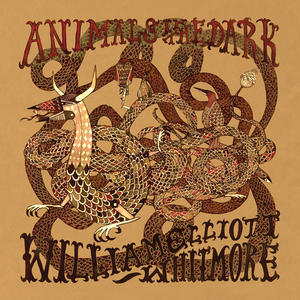
William Elliott Whitmore has been been releasing music since 2002 and this, his fifth album, could well be the one to elevate his status in the Americana, blues and folk community.
Animals In The Dark takes a defiant stance against authority and the people in power such as Johnny Law, The Captain and other characters that inhabit his tales. Though addressing current social and political themes, Whitmore frames them with a sound that is as old as the blues itself. The instruments are primarily acoustic with guitar, banjo and minimal drums providing most of the backing. His voice is without doubt his strongest asset and it sits front and centre in the mix with its raspy howl sounding like it contains the a century of dust and nicotine from the corners of rural America. It is no surprise to learn that Tom Waits is a label mate, a man possessed with a similarly grizzled style.
Whitmore outlines his modus operandi on the first track ‘Mutiny’ where he sings “There’s a sick sick wind that is blowing round and the captains got to go”. It is clearly a broadside at the now ex-president Bush and a call for the sailors to mutiny against their drunk captain who has taken the ship off course. Sounding like a prison chain gang song it effectively conveys the desperate feelings of many disillusioned Americans and the direction their country had been sailing for the last eight years.
‘Who Stole The Soul’ essentially addresses the same topic as the previous song but this time he approaches it from a sadder and more nostalgic angle with strings adding to the sense of loss that Whitmore describes in his lyrics.
In terms of the folk blues troubadours that are around at the moment, there are comparisons that can be drawn between Whitmore and Justin Townes Earle. They both share that torment and ache in their voices and they tell stories of an older country or they at least colour their songs with the phrasings and musical traditions of times gone by. The key difference between the two men is that Earle tends to focus on the heart and addictions whereas Whitmore takes, on this album at least, an outward perspective on the world and change that is needed.
Positivity does rear its head on ‘There’s Hope For You’ when he addresses a ‘little sparrow’, urging that there is hope for it but that it is too late for him. He can’t help but return to that sense of hopelessness, even in the face of change and the joy of a new life. It is very much a gospel tinged song with the organ driving the sermon in the vein of The Band. Even though an electric guitar fills out the back half, the song outstays its welcome for such a simple topic.
The banjo makes a welcome appearance in ‘Lifetime Underground’, alleviating the ever present emotional weight of Animals In The Dark. When it combines with an accordion a nice levity comes across like a Felice Brothers fairground tune. It is a key moment in saving the record from collapsing under its own grief. Whitmore must have been aware of the need to ease up on the darkness as he conjures up a country feel for ‘Let The Rain Come In’ with its pedal steel and the bar room plod of the drums.
Whitmore still lives on the farm he was born and raised on and he bring the album full circle by ending with ‘A Good Day To Die’. He floods it with personal images of sunshine, feeding the horses and swimming in the pond. He highlights the simple pleasures in life and the joy of the immediate things around you rather than the less tangible problems of the world and it ends the album on an appropriate note.
Animals In The Dark is a fairly heavy album in it’s intensity and delivery and some of the lyrics do verge on becoming too pessimistic and downtrodden. Whitmore does possess a devil howl of a voice though and listeners who are constantly seeking reprieve from the day glo sheen of much of today’s music may well find it in the dusty despair of William Elliott Whitmore.

 Doubtful Sounds